Month: June 2019

Stop Means Stop

Summary: Social Order at the Crosswalk

There is a German cliché: “Ordnung muss sein” (or, as I learned it, “Ordnung muß sein”). It literally means, “There must be order.” It expresses the German cultural appreciation for, and general adherence to, rules and social order.

I saw it expressed in the punctuality of trains and the extreme lengths to which my West German classmates went in their recycling (even removing, cleaning, and collecting the aluminum lids to their yogurt containers).

The level of adherence to social order and norms appeared to me to be greater in the DDR, at least out in public. In the privacy of one’s home, you might see a relaxing of the rules in both words and actions.

But in public, most citizens kept up the appearance of order and frowned upon those who did not. An especially vivid memory of DDR social order comes from crosswalks.

DDR Ampelmännchen or “little signal men,” designed in 1961

Interestingly, the designer of the of the East German crosswalk Ampelmännchen worried that the design would be rejected due to the hat. From a Spiegel article about it:

The hat could be a problem. The hat is the embodiment of capitalism, and that’s why Karl Peglau was somewhat anxious when he made his recommendation before East Berlin’s traffic commission on Oct. 13, 1961. Peglau, then 34 and the leading traffic psychologist in communist East Germany, was carrying his vision for a new pedestrian crossing signal in his bag. It was two men in red and green, and both wore hats.

But to Peglau’s surprise, the hats passed under the critical gaze of research councils and traffic officials without arousing complaint. In fact, the only thing they changed was the direction in which the figures were walking, switching them from right to left. Peglau’s concern that the hats would be rejected as petty bourgeois was “luckily not necessary,” he later remembered.

Here in the US, the crosswalk signal may be red, but if you perceive no traffic coming, many of us choose to cross rather than wait for a green light. Even if traffic is coming, some people dash across, in disregard of the signal.

I don’t recall, but I think it was a little lax in West Germany at the time I studied there. Since Tübingen was a university town, I suspect the foreigners, like me, were apt to cross against a red light, whereas many Germans might wait.

In Rostock, no one crossed the street when the light was red. It could be 10 p.m. with not a single moving vehicle or other pedestrian in sight … but people would dutifully wait until given the literal green light.

This took some getting used to for me. When other people were around, it was easier to emulate the group and remain frozen in place, seemingly oblivious to the absence of any visible traffic. But walking alone, it was really hard for me to remain stock-still.

The street and sidewalk in front of my student dorm

After a semester, though, I had grown accustomed to waiting for the green light and didn’t have to think about it.

When I left the DDR for the first time on a trip through Denmark, Sweden, and Finland, I had to readjust all over again.

When my Danish friends would start across the street against a red light, the upper half of my body began to follow them, but my legs and feet remained frozen. I leaned forward and nearly face-planted as my body argued with itself about whether to proceed.

I wonder, 30 years later, what my body would do if I saw the distinctive East German Ampelmännchen again.

A Visit To A DDR Grade School

Summary: Visiting a class of silent DDR grade-schoolers

One day Volker, a Rostock student who attended Brown University the year before I went to Rostock, took me and possibly others (I cannot remember) to visit a little elementary school in Rostock. He was going to talk about his time in the U.S.

My friend, Volker, and his wife

I was interested to see what Volker would say. I was also was eager to talk directly with the kids and see what, if anything, they thought about the world, the U.S., and me.

Volker at the entrance to Karl-Marx Schule, the grade school we visited

Volker gave a slide show that showed pictures of Brown University, cars, businesses, and the city. What I remember sticking out, though, was his picture of homeless people – something unknown in the DDR. Thirty years ago, Providence, R.I. had a few panhandlers near campus, but nothing compared to Boston, or NYC, or present-day Portland, Oregon.

The students watched in silence, and after Volker was done, he opened things up for questions and answers. He also introduced me, and assured them I spoke good German and would welcome their questions.

My memory is that there were no questions. The kids merely regarded us silently. I spoke up, wanting to assure the kids I could, indeed converse with them and that I welcomed any question they might have. Still, there were no questions.

As Volker and I left the classroom and the school, he shook his head with mild disgust. “This was a golden opportunity for them,” he grumbled, “and they just sat there.”

When Volker had visited American classrooms, the questions came hard and fast: Why do you call yourselves the German Democratic Republic? Why can’t people come and go? Why don’t you take down The Wall?

I had had a delightful conversation with three grade-schoolers during the May 1st holiday, which I wrote about here. I also visited a classroom in Hungary over Christmas ’88 and had a nice interchange. (I recall a poster of John Lennon on the classroom wall.)

Visiting Gyögyi’s classroom in Hungary

I cannot know why those Rostock students remained silent. Did they feel self-conscious? Were they worried about judgment by peers or teachers? I cannot imagine kids not being naturally curious or inquisitive. I can only wonder to this day what might have been going through their heads.

Getting Sick in the DDR

Summary: Experiencing Socialized Medicine in an Actual Socialist Country

I rarely get sick. Maybe once every couple of years I might feel poorly enough to take a day or two off work. The number of times I’ve been to the doctor due to feeling bad or with an urgent concern could be counted on a single hand.

But I got sick in the DDR. I don’t recall the details of my symptoms, but it must have been pretty bad to motivate me to undertake the challenge of going to the doctor in a foreign country.

I can’t remember, but I assume the physician was associated with the university. The office was old and drab, like something out of a ’50s movie scene, and the equipment wasn’t shiny or state of the art.

I recall the doctor was a woman: efficient and no-nonsense. After checking various vitals and asking me a few questions, she wrote up a prescription. It was on a paper receipt, and like the cliché, the handwriting was scribbled and completely unintelligible to me.

Having no clue about what I was to get or where to go, I think I asked the doctor’s receptionist where I should go next. She brusquely said any pharmacy, and pointed me in the direction of the nearest one.

I walked in and waited my turn. When I passed my handwritten prescription to the pharmacist, I watched with growing concern as they fetched more and more items. A dozen tablets, four brown bottles of some unknown liquid, maybe something further.

I tried to remember how many East German marks I had on me. Had I brought enough money for this?

After a small cafeteria tray’s worth of items were presented to me, the pharmacist turned away and called the next customer.

“Um, how much does this cost?” I asked. “Nothing,” came the flat, perfunctory response.

I felt conflicted. Surely I needed to pay something. So I asked to buy some facial tissues. The total cost to me was probably less than 25 cents US.

Mine was just a brief, minor experience. Yes, the technology and facilities may have been antiquated, but they were available to everybody. I had to pay nothing, and I was not even a citizen of the country.

I know of rural regions of the U.S. that would be happy to have any facilities, even those from the DDR 30+ years ago.

I’ve often thought back to that experience in subsequent years. When discussions turn into heated debates over the pros and cons of “socialized medicine” versus the for-profit US healthcare system, I am often amused when people fervently tell me of the ills and horrors of socialized medicine.

I find the most emphatic and impassioned arguments against any centralized or government-run healthcare system often come from people who have never been abroad, much less to an actual socialist country. Of the few that have travelled abroad, most of them have typically never received medical care in any Western European or Asian country.

Decades before heated debates over “Obamacare,” I would sometimes quip that I’d take the DDR healthcare system of a 30 years ago over the present-day US system. The latter, though state-of-the-art, is unavailable to far too many citizens, and bankrupts those who have the audacity to get seriously ill.

It is fascinating to me to see how discussions of single payer, Medicare-for-all, and other potential healthcare and insurance plans have transformed from complete political non-starters to accepted and promoted planks of many mainstream candidates.

Long Distance Phone Calls in the DDR

Summary: Using and abusing pay telephones in the DDR

In 1989, international phone calls were expensive and the sound quality mediocre. It’s easy to forget this today when video phone conversations with excellent fidelity that connect multiple chatters from around the world can be made with your smart phone — and for free! I hosted one such video call with 10 friends just last month!

Back then I remember making international phone calls from home. You had to dial a long sequence of numbers on a rotary dial, hoping you didn’t make a mistake, could reach your party, and would get a decent connection.

Phone calls to and from the DDR were even more challenging. You couldn’t call the US from DDR phone booths.

For that, you had to go to the post office. There, you would go up to a teller, give him or her the number you wanted to dial, then sit down and wait until you were summoned. When you were ready, the teller directed you to a private numbered stall. There, you would make your phone call. Afterward, you would return to pay the teller for the call.

People in the US could call directly to us. But there was only a single phone for incoming calls in the whole dorm, and my dorm was at least 12 stories tall. Each dorm had a little entry office staffed by students. Every day when you left, you’d give them your key, and when you came in, they would return it to you. That little office was also where the single telephone was located.

These two dorms were Hochhaus 1 and 2. I believe I was in #2. There was one phone per building.

If someone from the US called, the student in the key office would have to dash out, or send someone to fetch you. That student would take the elevator up (if it was functioning) or climb the stairs to your floor, knock on your door, and the two of you would dash back down to the entry office to take the call.

My friend, Mirko, in the dorm key office on the only phone in the building

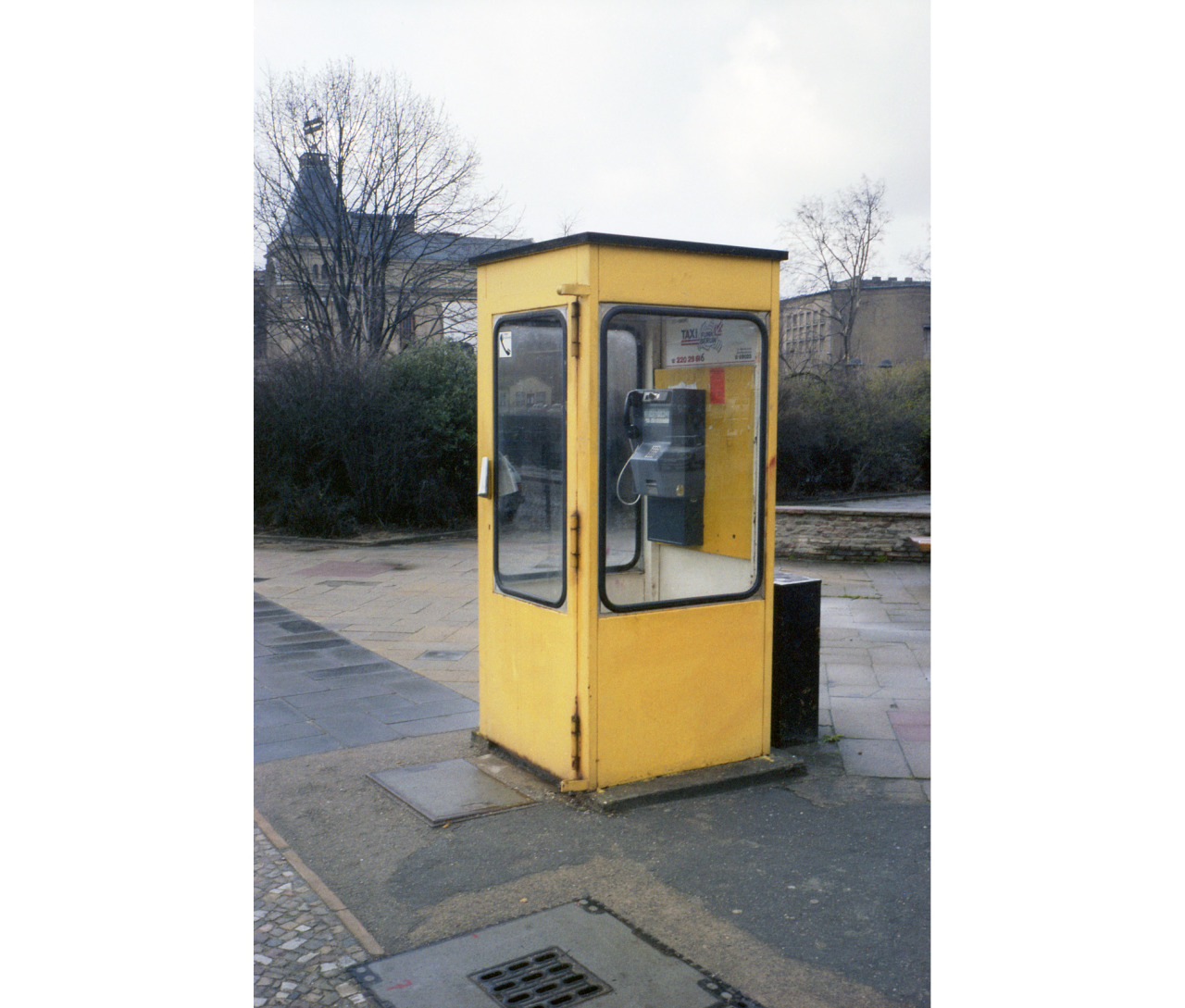
Pay phones were relatively easy to use, but they could only be used for phone calls within Europe. Here is a picture that looks similar to what I remember:

Pay phones had three separate coin slots, with a column of lights beneath each. Before making a call, you would insert up to three coins into the appropriate slot. They would stack up, and the lights would illuminate to indicate how many coins were queued up.

As the phone call progressed, the bottom coin in the stack would drop, and the column of lights would shrink by one. This showed you how much credit you had left.

When all coins were used up, all the lights winked out. When that happened, your phone call was terminated. If you wanted to keep talking, you would have to keep adding coins so that at least one light remained on. If coins were left at the end of your call, they were returned to you.

Sometimes pay phones would be sabotaged. The common method was to affix a fine thread or fishing line to a coin, drop the coin in the slot, then secure the other end of the line with tape or a knot. When the phone would try to drop the coin, since it was suspended by the line, it would remain — and the single light for that coin would stay illuminated.

In this way, you could make the longest call you wanted for the cost of that one coin. Anyone after you would enjoy free calling.

It was obvious when a phone booth had been sabotaged: a long line of foreign students would be queued up outside it. Each would wait patiently for his or her turn. I recall making at least one phone call to friends in West Germany and maybe to Finland on one of these rigged phones.

I once attempted to recreate this mechanical swindle … and failed. When I dropped my coin in the slot, the string followed, and was completely ingested. I feared the next caller would discover the problem. I had no desire to be caught, so I quickly departed.

My life as a phone saboteur in the DDR lasted less than five minutes.

Cold War Stares

Summary: Conspicuous Westerner receives, eventually returns, long stares

The difference between studying in West Germany and East Germany was like night and day. The colors were muted and drab in the DDR. Goods available for purchase were limited in variety and often of mediocre quality.

And there were very, very few foreigners. What really stood out about studying in the DDR was, well, how much I stood out.

In Tübingen there were well over a hundred students from the US and the UK. They’d gather to drink, smoke, play cards, and speak English. I generally avoided those groups.

I have always hated smoking, and I wanted to continue to improve my language skills and interact with Germans. Why come to Germany only to hang out with English speakers?

When I walked down the street or through the center of Tübingen, no one would give me a second glance. In Rostock, the absolute opposite happened.

There were only about ten students from the West in Rostock, and we stood out like flashing neon lights wherever we went. If I boarded a streetcar, everyone on board would turn to look at me … and continue staring for an uncomfortably long time.

Normally, when you walk down the street or sit in a park, if your eyes happen to meet those of a stranger, you immediately look away. You might smile or nod in silent greeting, but that moment rarely lasts more than a fraction of a second.

Imagine sitting in a bus or a streetcar, and when you meet someone’s gaze, the connection locks and you find yourself eyeing each other for 5 to 10 seconds. That feels like an eternity. And if you look away to someone else, you find that she, too, is looking at you!

There was never a smile or a nod. It wasn’t a blank stare or a nosey, inquiring look. It wasn’t quite a glare or scowl of judgment. Just a neutral, unsmiling gaze, like the vacant black-and-white countenance in many a foreigner’s passport photo.

I found this very unsettling. The voice in your mind asks whether something is wrong with you: a stain on your shirt, your hair mussed, food hanging from your cheek. You try to remain calm, but inside you are going through an inventory of all the things that might elicit such discomfiting stares.

Often, I’d feel their eyes directed at my clothes, whatever I might be carrying, etc. I was told that even if I wore East German clothes, my shoes would give me away, since the variety of footwear available to purchase in the DDR was scanty.

Finally, I realized, “Hey, if they can look at me, I can look back at them!” So I’d stare back. Unsmiling, neither inviting nor defensive, I’d take my time to study their faces, hair, clothes, avoiding any hint of judgment, attraction, or fear.

As Americans, we are socialized to smile. It took some practice to break that habit. Thinking back on it now, I’m reminded of many moments in the Sherlock Holmes adventures, when the famed detective would study and scrutinize a client silently, then come up with a miraculous narrative about that person’s recent and distant past, education, employment, and so on.

My deductive skills were nowhere near the realm of even a mediocre investigator, but being able to allow myself to gaze back at strangers was an unusual and surprisingly fascinating experience, one I have never seen or experienced since.

Judging the Other Side

Summary: Spending a semester in either half of the formerly divided Germany gave me an opportunity to compare the attitudes of each about the other.

It was my impression that the West Germans generally held attitudes of pity and superiority over their Eastern peers. Those who had traveled to the East came back with strengthened feelings of their transcendence, having witnessed the scarcity of goods, inferior and air-fouling automobiles, and countless drab colored buildings frozen in states of disrepair, like faded, living 3-D photographs from WWII.

They scoffed at the tiny East German currency, including the lightweight pfennigs pressed out of aluminum. They bemoaned the oppression, the informants (real and imagined), and the lack of freedom their Eastern peers labored under: prevented by walls, barbed wire, and armed soldiers from leaving to visit friends and relatives, or to purchase Western goods.

Even in Hungary, where the Iron Curtain opened to travel and trade with Austria just months earlier, I heard dire stories about how “they have nothing” in the DDR. I spent a month during Christmas break in Hungary after completing my semester in West Germany, just before I started my semester in Rostock, DDR.

On the East Germany side, despite a healthy and constant stream of anti-west propaganda, I heard few denigrating comments about the West. As one might hear in most countries in the world, any differences they felt for other countries was mostly directed at the government and foreign policies, not individual citizens.

On the 1st of May, people dutifully carried banners decrying the fascism and imperialism of the West and parroting the slogans of the Socialist Revolution. But I never perceived the fervor — the emotion behind the words — and never encountered anyone who sought to convince me either of the advantages of socialism or the evils of capitalism.

Did they want to leave the DDR? Yes, but mostly just to visit friends and relatives, purchase Western goods, and just generally check things out. Although they might grumble about conditions, corruption, oppression, etc., none of those complaints convinced me that the Berlin Wall would fall anytime soon.

The Museum at Checkpoint Charlie was a popular tourist site, but I never went. I knew people had tried to escape and had been killed for it, and I knew I would be upset by those stories. I further expected predictable self-congratulation bordering on nationalism to color the narrative and photos on display. The visit of one of my classmates confirmed my suspicions.

Louise visited West Berlin and Checkpoint Charlie well into our semester of study in Rostock. There she overheard a docent — a U.S. military person, I believe —regale some visitors with tales of how terrible life was in the DDR: little to eat, no freedom, crushing oppression, etc.

She stepped up and interjected that although things might be a bit poorer, people actually lived comfortably, though maybe not extravagantly in the DDR. The docent retorted in a strong American accent, “well, yerrrr an Amerrrican. Yerrrr freeee. You can go in, check it out, and leave when you wanna.”

I remember conversations with a Rostock student, Volker, who had spent a semester or year studying at my alma mater, Brown University. What struck him about the West were the homeless people he saw. In the DDR, people may not have been rich, and some were poor.

But you never saw homeless people, people starving, or people begging on the streets. That stark contrast really hit me when I left the DDR, and again later when I traveled in Japan.

When German reunification (Wiedervereinigung) occurred, I got the sense that the West Germans were eager to free their Eastern brethren and sistren from the oppression of socialism and share with them the fruits of capitalism and associated freedom. That enthusiasm waned, and in some cases turned to anger as the rising costs of rebuilding the former DDR put a great strain on the great former West German economy.

Meanwhile, former DDR citizens, used to a stable albeit modest existence, were now faced with the sometimes rapacious excesses of western capitalism. I can only imagine the giving and receiving of “Vitamin B” significantly decreasing.

Today, we see groups of people in Russia long for the security and stability of former U.S.S.R., including its concomitant oppression. I can only wonder how many people remember and long for the life in the former DDR.

As wealth inequality increases in the U.S. and other western countries, one hears more and more calls for more regulation and Scandinavian-style socialism. A label that would have spelled political death just a few years ago is now embraced and proudly promoted by candidates that are winning numbers well beyond the fringes of decades past.

I think it is clear that people recognize more and more that it is not simply an either-or choice between capitalism and socialism. There are lessons to be learned from the two Germanys that became one.

Baby Carriages and Maternity Leave

Summary: Babies in baby carriages were left safely and undisturbed outside stores and classrooms in the DDR.

When I walked the streets of Rostock back in 1989, it was not uncommon to see baby carriages parked outside stores, unattended and safe while mothers inside shopped, or more frequently, waited in line.

Outside university classrooms and lecture halls, one would often see a collection of strollers. Infants lay peacefully and completely safe from mistreatment, abduction, or neglect. These images remain sharp in my mind’s eye, and I kick myself, again, for failing to take photographs of them.
Update: Happily, my friend, Louise sent me a picture of bunch of strollers parked outside a shoe store:

Baby carriages parked in front of a shoe store

The DDR encouraged and supported pregnancy and birth, and provided mothers a lot of assistance. There was an extensive network of day care centers. Mothers received a year of paid maternity leave.

East German women had more babies than their Western counterparts, had them earlier, and were still able and encouraged to study or work (though I don’t recall there was an expectation or pressure, economic or otherwise, to do so).

I sensed a distinct absence of shame or judgement imposed on unmarried women who gave birth or raised children alone. At the same time, gender stereotypes in the DDR working world were dwarfed by those in West Germany and other western countries.

Women could be crane operators, scientists, and academics without condescension. Not that there was no sexism, but it certainly seemed closer to an equality I’ve never seen at a societal level in the U.S.

Today, thirty years later back home, many women still have to juggle career or child care, weighing the economic burden of raising children and the likely negative impact on their professional careers.

Today, the U.S. is still the only developed nation that does not mandate paid maternity (or paternity) leave. Certain companies may offer some form of maternity/paternity leave, but only four U.S. states offer publicly funded leave. Most European countries provide between 26 and 58 weeks, although Hungary and Finland allow 160 and 171 weeks, respectively.

Today in Germany, I doubt a baby carriage would be left unattended without concern, shame, or risk of arrest for neglect and endangerment. I’m not certain, but I think possibly Japan or Singapore might be the only countries where it remains safe enough to do this.

Vitamin B

Summary: Relationships fed through unexpected generosity helped people navigate shortages and overall lack of goods.

Folks in the DDR often spoke of “Vitamin B” (pronounced “veet-uh-min bay” in German). This was shorthand for “Vitamin Beziehung.”

Beziehung means relationship or connection. One way people would show their loyalty and friendship to each other was through quiet, unexpected gifts and services. I saw this repeated many times the semester I was there.

I was visiting the family of one of my classmates. Her parents lived in a small town, and her mother owned a photography shop. She insisted on developing and printing all my black and white photos free of charge, despite my repeated protests.

This was well before the era of digital cameras. At the time, color film and prints were pretty uncommon in the DDR. I had taken color photos during my Christmas break in Hungary, but pictures came back with muted colors and sepia tones. They looked faded and old, fresh from the fotomat.

So the majority of photos I took during my time in Rostock and the DDR were black and white. My old Asahi Pentax Spotmatic performed well. I even found and purchased some screw-mount lenses in the DDR for it.

One day, I accompanied my friend’s mom to the little grocery store. She bought a few items (eggs, butter, milk, a few vegetables). The grocer slipped an extra wrapped item into her bag. Nothing was said, although there might have been a slight nod or a smile during the exchange. We waited until we got home before unwrapping the package to find a fresh cucumber.

It was quiet and subtle, a private exchange, not an ostentatious or gauche public display of one’s largess. Thinking back, people standing nearby might have glimpsed it, but they said nothing and registered no acknowledgement.

This was “Vitamin B” in action. The grocer was showing appreciation, loyalty, and generosity to my friend’s mom, who probably had done, or would do, favors in return for the store owner.

In a society filled with imagined and real informants and Stasi collaborators … where goods, especially fresh produce, were easier to find in a private garden than at the grocery store … where customers normally could not touch or handle objects before purchasing — perhaps Vitamin B provided a moment of warmth, connection, and loyalty between human beings. I have to wonder if the prevalence of Vitamin B dissipated after the fall of the Berlin Wall.

Nudity in Germany

Summary: FKK and nudity in Germany

Germans are quite comfortable with nudity. The majority of beaches I visited in both West and East Germany were either topless or fully nude. Some beaches were nude except for a small “clothing” section … which was topless.

The Germans have a term for this: FKK. FKK stands for Freikörperkultur, which translates to “free body culture.” To them, there is no immediate, inextricable association between a nude body and sex. It’s just a body.

On one occasion, a German friend who visited me in Tübingen needed to change her clothes. So she did, right there in the dorm room next to two American guys (me being one of them). Off came her blouse and pants, and on went another set of clothes. No fuss, no hesitation, no embarrassment.

A day too cold to disrobe at the beach at Warnemünde

At the beach, it’s not just the “beautiful people” who go without clothes. Mom, dad, uncle, aunt, grandma, kindergartener — everyone goes without restriction or coverage. One sees all body types, from skinny to corpulent, and from baby-smooth skin to flesh that shows the inevitable sag, scars, spots, and wrinkles of time.

I had to admit, this was a great way for kids to learn about bodies. Rather than the homogeneous forms in human biology books and health class, or the unrealistic and enhanced figures in advertising and adult media, here was a way to see and acquaint oneself with the human body in all its sizes, forms, and ages.

Coming from the fairly prudish USA, this took some getting used to for me. Visiting the beach at Warnemünde, I found it especially awkward getting nude in the company of students I sat with in class.

All the insecurities and fears hounded me. What would they think of my body? What if I do something embarrassing? What if I become … excited?

After about 10 or so minutes, having seen it was no big deal to anyone else, I relaxed and willed it to be no big deal to me, either. I began to enjoy the feeling of being free and unrestricted.

No sand chafing under my waistband or getting wedged elsewhere. It felt … great. I grew to really enjoy this unique experience, although I had to be careful to avoid sunburn.

After returning to the US, my first trip to the beach was in Newport, Rhode Island. My first instinct at that point was to drop my swimming trunks, run across the sand, and leap into the ocean.

If I had, my friends would have been mortified, strangers would have reported me, and I would have been arrested as a sexual deviant and danger to others.

I cannot help but wonder which approach to nudity is more healthy for the individual and the society.

The Last May 1st in the DDR

Summary: Chatting and laughing with kids on what was to be the last International Workers’ Day in East Germany.

May First is celebrated as “Labour Day,” or “International Workers’ Day” (the US and Canada celebrate it on the first Monday of September). The holiday was started in the late 1800s by socialist and communist political parties to commemorate the 1886 Haymarket affair in Chicago.

Workers were striking for an eight-hour work day, police killed eight of them, and a bomb and ensuing gunfire killed seven officers and at least four civilians. Although the holiday is observed around the world, it is unsurprisingly an especially big event in socialist and communist nations.

In May 1989, I was visiting Froburg, a small town about 12 miles south of Leipzig. This was the hometown of Dörthe, roommate to one of the other American students studying in Rostock with me. We enjoyed the hospitality of Dörthe’s parents who toured us around the area.

On May 1st, there was a parade through town. Marchers carried banners with slogans such as “Fight the Fascist Capitalists!” The parade ended at a town hall and most of the people went inside to eat and drink.

Hanging outside were three grade-school kids, maybe 2nd, 4th, and 5th graders. Let’s find out what good little socialists these kids are, I thought to myself. So I approached and engaged in a conversation with them (in German, of course).

“What does this day mean to you?” I asked.
“We don’t have to go to school!” they exclaimed gleefully. Kids are the same all over the world!
I continued, “you probably can guess that I’m not from Germany, right?” They nodded. “Where do you think I’m from?”
“Ummmmm, France?”
Nope.
“England?”
“No, but you are getting closer,” I replied.
They scrunched up their faces and pondered, and gave up.
“I’m from the USA,” I finally revealed.
“Ah, USA,” they repeated.
“Do you where the USA is?” I asked.
“No!” they answered in chorus.
“Is there anything, anything at all you know about the USA?” I persisted.
They thought about it for a while, and then the youngest struggled out an answer: “Die USA ist ein kapita… kaptital…kaptitali…”
“Ja, Die USA ist ein kapitalistischer Staat” (“yes, the USA is a capitalist country”).
“Does anyone know what that means?” I asked.
“No!” they all responded together.
We laughed and continued talking.

I enjoyed hanging out with the kids. One of them removed the little red scarf they all wore as young “pioneers of the revolution” and gave it to me. I still have the scarf. I’ve also kept a copy of an East German newspaper from May 1st, 1989, covered with anti-capitalist slogans like the ones on the banners from the parade.

The fall of the Berlin Wall and the end of the DDR would occur just six months later, but in that town, chatting and laughing with those kids, I would never have predicted it. I cannot help but wonder what became of those kids, who now would be grown and likely have children of their own.

Updated August 2, 2021:

With the help of another former exchange student who still lives in Germany, I made contact with a reporter for a small monthly newspaper in Froburg. She agreed to post these two pictures along with my message asking for help identifying and locating these three kids. The July issue of the Frohbuger Nachrichten was published, and you can find the entry on page 24.

Front page of the Frohburger Nachrichten, July, 2021

Within days of publication, I received email from the former little boy, named André, and the older girl, Peggy. Peggy writes she was 13 when the pictures were taken, and her younger sister, Susann was 11. The two sisters are both married with children and living in Bavaria. André is their cousin. I hope to continue corresponding with the three former children and learning about their life journeys.

I also received an email from the roommate to one of the other American exchange students to Rostock. I am delighted to reconnect and am thoroughly enjoying the memories that are coming back as we continue to correspond!